
Klar Partners Ltd / Oleter Group Pest Control Roll-Up Strategy Explained
klar partners ltd / oleter group pest control roll-up strategy: The European pest control industry has always been full of small, local businesses. Each town often had its own company, run by people who knew their customers well. That personal touch was great, but it came with a problem: service quality could be all over the place. Some companies used modern tools and methods, while others relied on outdated approaches. Growth was slow, and many businesses struggled to expand beyond their local area.
Now, things are changing fast. Klar Partners Ltd and Oleter Group are leading a major shift in the way pest control works across Europe. Their roll-up strategy combines many small companies into one larger, more efficient network. This isn’t just about buying businesses—it’s about creating a system that improves service, introduces technology, and makes operations smoother.
For customers, this means more reliable service, faster responses, and better communication. For investors, it’s a smart way to grow in a stable industry. In this article, we’ll break down exactly how this roll-up strategy works, why pest control is perfect for it, and what it means for customers and the European market as a whole. You’ll see how small local companies are becoming part of a bigger, smarter network.
How the European Pest Control Market Works Today
Fragmented landscape and small local companies
For decades, European pest control was all about local businesses. People called small companies nearby because they knew the owners personally. These businesses were often family-run, deeply connected to their neighborhoods, and highly trusted by customers. That personal touch was a real strength, but it came with limits. Each company had its own tools, methods, and service standards, which meant quality could vary dramatically from town to town. In one city, you might get fast, professional service, while in another, appointments could take days, and treatments might feel outdated.
Many small companies couldn’t afford modern software, digital booking systems, or advanced equipment. Hiring enough staff to handle larger contracts was often impossible. Even though these businesses had loyal customers, their ability to expand beyond a local area was limited. Without centralized systems or shared resources, they couldn’t scale efficiently. This patchwork approach worked well for trust and familiarity but left the industry uneven and uncoordinated.
Challenges of inconsistency and limited growth
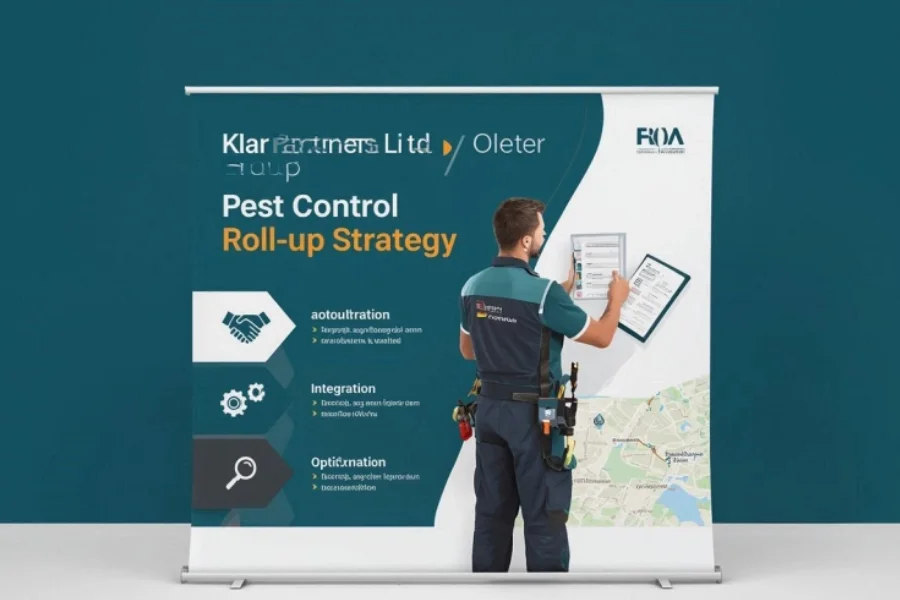
The inconsistency in service quality created real problems for customers and partners. Some small firms were fast and reliable, while others struggled with scheduling or outdated techniques. For insurance companies or businesses relying on pest control contracts, this unpredictability made planning difficult. Customers often felt frustrated when they didn’t know exactly what level of service to expect.
Growth was also a big hurdle. Many small firms lacked capital to invest in technology, marketing, or extra staff. They couldn’t take on bigger commercial projects or expand into neighboring towns. Even when they wanted to modernize, the cost and complexity of upgrades often kept them stuck at a local level.
This mix of challenges created gaps in the market. Larger organizations could step in, offering consistent service, shared resources, and the ability to scale across multiple regions. It became clear that consolidating smaller companies could solve many of these problems.
Opportunities for consolidation
The fragmented state of the European pest control market also created a huge opportunity. With hundreds of small, independent companies operating separately, bringing them together under a unified system became a smart way to improve efficiency.
For the businesses themselves, joining a larger network opens doors to investment in modern tools, staff training, and marketing that they could never afford alone. They can expand beyond their hometowns while keeping the local relationships that made them successful in the first place. In practical terms, consolidation turns a patchwork of small firms into a strong, organized network that benefits both customers and businesses.
What a Roll-Up Strategy Means
Simple explanation of buy‑and‑build
A roll-up strategy is a smart way to grow a business without starting from scratch. Instead of building new offices, hiring a big team, and creating systems from the ground up, investors buy several smaller companies and bring them together under one umbrella. This approach is often called buy‑and‑build.
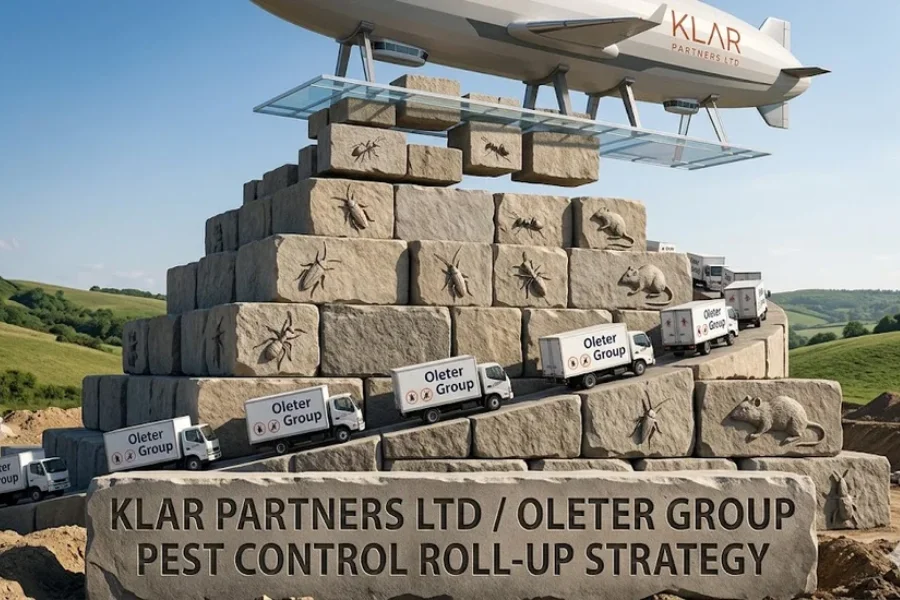
Imagine each small company as a Lego block. Alone, each block is useful but limited. Snap them together, and you can create something bigger, stronger, and more stable. The combined group can share resources like scheduling software, staff training programs, marketing tools, and operational systems. This makes each company more efficient while also allowing the whole network to expand faster than any single business could on its own.
The beauty of a roll-up strategy is that it doesn’t erase what made the small businesses valuable in the first place. Their local knowledge, customer relationships, and expertise remain intact. They simply gain new support to modernize and scale.
How klar partners ltd / oleter group pest control roll-up strategy execute
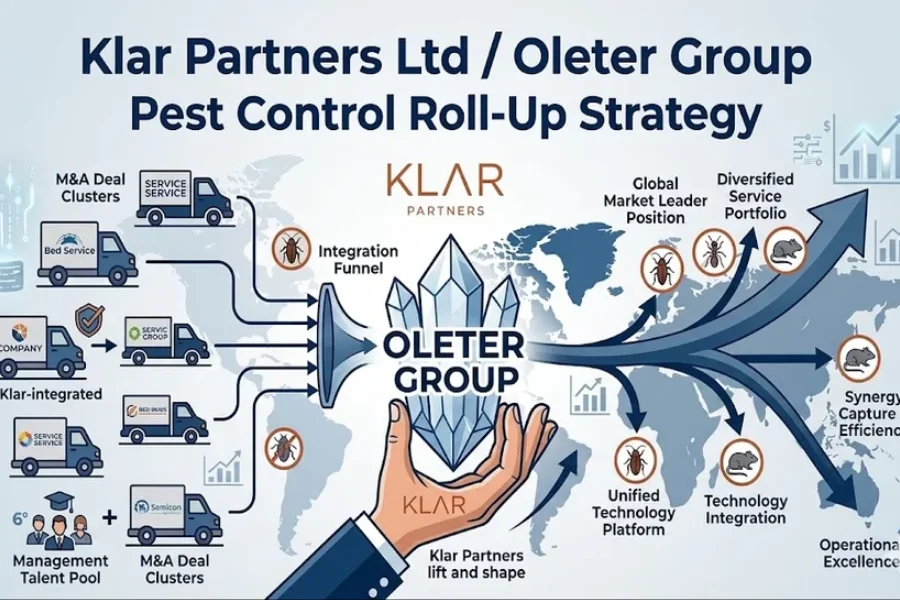
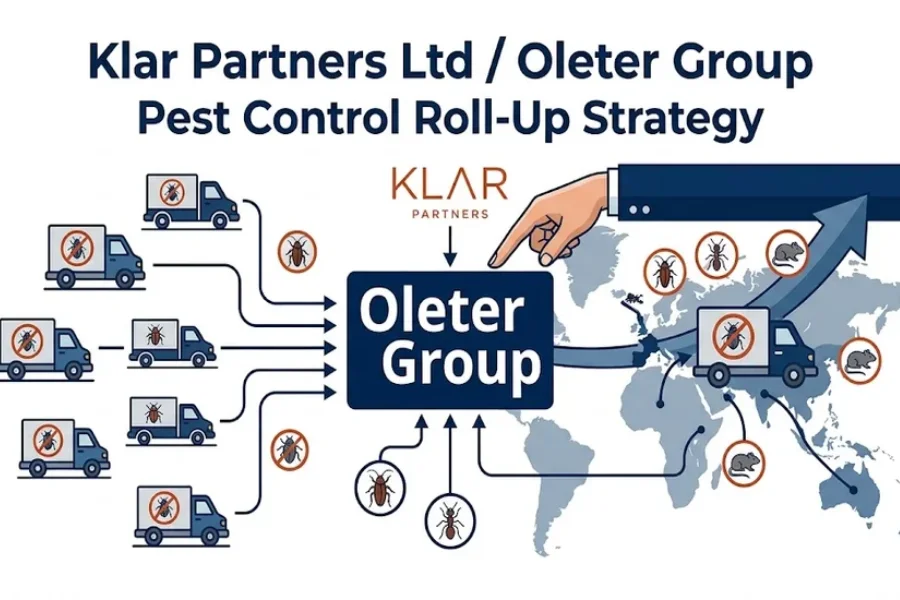
Klar Partners Ltd provides the funding and strategy for the roll-up, while Oleter Group acts as the operational engine that makes it happen. Klar Partners identifies industries with growth potential, like pest control, and invests in a platform company. Oleter Group then finds strong local businesses, acquires them, and integrates them into a larger network.
This process doesn’t replace local teams. Instead, employees stay in place, keeping the relationships and trust they built with customers. What changes are the systems behind the scenes: scheduling, reporting, training, and technology are standardized and upgraded. Local teams gain access to tools they couldn’t afford on their own, which improves efficiency and customer service.
By combining investment and operational expertise, Klar Partners and Oleter Group create a network that is bigger, more organized, and better equipped to serve multiple regions. It’s growth without losing the personal touch that customers value.
Why Pest Control Is Perfect for Roll-Ups
Recurring demand and stable revenue
One of the biggest reasons pest control works so well for roll-ups is the recurring nature of the business. Most customers don’t just call once to get rid of pests and never think about it again. Instead, many choose ongoing contracts to prevent future infestations. This creates a steady stream of income that is predictable month after month. For example, restaurants, hotels, and office buildings often schedule regular inspections and treatments to stay compliant and safe. Even homeowners may set up seasonal or annual pest control visits.
This repeat business makes financial planning much easier. A company can forecast revenue with confidence because customers will keep coming back. Investors like this predictability—it reduces risk and makes it easier to grow the business. When you combine recurring income with operational improvements from a roll-up, the business becomes even more attractive.
Fragmented market makes acquisitions easier
Europe’s pest control industry is highly fragmented. In many countries, there’s no single company dominating the market. Instead, there are hundreds of small local operators, each serving a specific area. This scattered structure creates a lot of opportunities for a roll-up strategy. Companies like Oleter Group can acquire these smaller firms one by one, gradually building a larger, more efficient network.
Fragmentation also means these local businesses often haven’t adopted modern systems or technology, leaving room for improvements. When multiple small companies are combined, the network benefits from shared resources, standardized processes, and advanced tools. For a consolidator, this is like picking up many small pieces of a puzzle and assembling them into a strong, scalable business. Growth can happen faster than if a single company tried to expand alone.
Advantages for investors
Investors are naturally drawn to pest control because it hits all the right points: steady demand, good profit margins, and clear growth potential. Regular contracts ensure predictable cash flow, and recurring business allows investors to plan for the long term. Unlike seasonal industries or ones sensitive to economic swings, pest control is essential—people and businesses will always need it.
On top of that, the fragmented market means consolidators can grow quickly by adding small companies to a larger network. Each acquisition adds value by increasing efficiency, standardizing operations, and expanding service coverage. Over time, the combined company becomes far more valuable than the individual businesses were on their own. This combination of stability and growth potential makes pest control one of the most attractive sectors for private equity and roll-up strategies.
How Companies Are Acquired and Integrated
Finding strong local businesses
Not every small pest control company is a good fit for a roll-up. Investors like Klar Partners and operators like Oleter Group look for businesses that already have a strong foundation. This means loyal customers, steady recurring income, and a solid reputation in their local community. Even if the company is small, these qualities make it a valuable building block for a larger network.
Local trust is one of the most important assets a small company brings. Customers know the team, rely on their expertise, and often stick with them for years. By acquiring these businesses, the roll-up doesn’t start from scratch—it inherits customer relationships that are already strong. The key is finding companies that are reliable and well-run, so the integration adds value instead of creating problems.
Gradual integration and cultural alignment
Acquiring a company is just the start; integration is where the real work happens. The goal isn’t to erase local culture or processes but to merge them carefully into a larger system. Sudden changes can confuse employees or disrupt customer service, so Oleter Group takes a gradual approach.
Employees usually keep their roles and continue serving customers as before. At the same time, they gain access to new tools, shared systems, and additional training. This helps them adjust smoothly without losing the practices and knowledge that made them successful locally. By respecting the company’s culture while introducing improvements, the integration builds long-term stability and trust.
Operational and technology upgrades
Many small pest control firms still rely on manual processes—paper records, basic spreadsheets, or phone-based scheduling. Joining a larger network allows them to modernize. Companies gain access to digital scheduling, route optimization, customer databases, billing systems, and team communication apps. These tools save time, reduce errors, and improve customer service.
Technology upgrades also make coordination across multiple locations easier. For example, if one area has higher demand, technicians can be reassigned efficiently. Data from different sites can be shared to improve performance and predict future needs. This transformation turns previously isolated firms into a connected, high-performing network that works faster and smarter.
Benefits of the Roll-Up Model

Standardization of services and quality
Before consolidation, the pest control experience could vary widely from town to town. One city might have highly trained technicians using modern methods, while another relied on outdated approaches and inconsistent processes. This made it hard for customers to know what to expect and sometimes caused frustration. Roll-ups like the Klar Partners Ltd / Oleter Group model solve this by introducing standardized systems across all acquired companies.
Every location follows the same training programs, service protocols, pricing models, and reporting tools. For example, technicians in Sweden and Norway receive the same safety training and use the same inspection checklists. Customers calling from different regions now receive consistent, professional service. This standardization also ensures that quality doesn’t depend on a single person or local manager but on reliable systems that scale across the network.
Technology improvements across the network
Technology is a huge part of the roll-up’s benefits. Many small pest control companies still manage appointments on paper or simple spreadsheets. When they join a larger network, they gain access to advanced digital tools. These include scheduling software, route optimization apps, customer databases, and communication platforms.
Using the same technology across the network improves efficiency and reduces mistakes. Teams can schedule jobs faster, track treatments accurately, and communicate clearly with customers. For instance, if a technician needs to reschedule a visit, the update is instantly visible across the system, preventing delays or double-booking. Shared platforms also allow management to monitor performance across multiple locations, helping the company identify areas for improvement quickly.
Operational efficiency and economies of scale
One of the most practical benefits of a roll-up is operational efficiency. By merging companies, resources like training programs, marketing budgets, and software subscriptions can be shared. This reduces overhead costs while improving capabilities.
For example, buying pest control equipment in bulk lowers costs for the entire network. Centralized planning helps technicians spend less time driving between jobs, which increases productivity. Staff can also be redeployed based on demand, ensuring faster responses in busy areas. Over time, these efficiencies improve profit margins and allow the network to invest in further growth or better tools.
Regional expansion, especially in Nordic countries
The roll-up strategy has been particularly effective in Nordic Europe, including Sweden, Norway, Denmark, and Finland. By acquiring small local companies in each country, Oleter Group has built a regional network under one brand and system.
This cross-border presence allows them to serve more customers consistently and efficiently. Clients with multiple locations or regional partners benefit from a single point of contact and standardized processes. It also strengthens the company’s competitive position, as smaller independent operators can’t match the coverage or coordinated services of a larger network. Expansion creates a strong, unified brand that’s recognizable and trusted across multiple countries.
Challenges and Considerations
Balancing standardization with local flexibility
Standardization is a core benefit of roll-ups, but it can also create challenges. When every company follows the same procedures, there’s a risk of losing the personal touch that made local businesses successful. Customers may feel like they’re dealing with a large, impersonal organization instead of a familiar local team.
Oleter Group addresses this by keeping local staff and management in place while gradually introducing standardized systems. For example, technicians continue to visit homes and businesses they already know, but now follow unified reporting and safety protocols. This allows the company to maintain quality and efficiency without erasing the unique strengths of each location. Gradual changes help both employees and customers adjust comfortably, preserving trust while improving service.
Employee adaptation and cultural shifts
Merging small companies into a larger network can create uncertainty for employees. Staff may worry about new reporting lines, software, or company policies. Even if the changes are beneficial, adaptation takes time and support.
Successful integrations focus on communication and trust-building. Managers spend time explaining why changes are happening, providing training, and showing how employees will benefit. For instance, access to better tools and centralized support can make daily work easier and more rewarding. Over time, employees gain new skills, feel more confident in their roles, and develop stronger ties to the larger network.
Risks of rapid expansion
Growth is exciting, but expanding too quickly can create serious problems. If multiple acquisitions are integrated at once without proper planning, service quality may drop, employees can feel overwhelmed, and customer satisfaction may decline. Systems may fail to keep up with increased demand, reducing efficiency instead of improving it.
To avoid these risks, Oleter Group focuses on controlled, gradual growth. Each acquisition is carefully planned, integrated step by step, and monitored for operational stability. This ensures that quality, customer trust, and staff morale remain high while the network grows.
Final Words
The European pest control industry has long been made up of small, local companies. These businesses built trust through personal relationships, but service quality often varied, and growth was limited. Many couldn’t afford modern tools, advanced scheduling, or larger teams, keeping them confined to their towns.
Now, Klar Partners Ltd and Oleter Group are reshaping the market with a roll-up strategy. By acquiring and connecting strong local companies, they create a larger, more efficient network. Local teams stay in place, maintaining trusted customer relationships, while gaining access to standardized systems, technology, and training. This improves service, response times, and operational efficiency.
Pest control is ideal for this approach because of recurring demand and a fragmented market full of small businesses ready to join a network. Customers benefit from consistent, reliable service, employees gain support, and investors enjoy predictable growth. This roll-up model is turning a patchwork of small firms into a coordinated, modern European pest control network.
Follow Feed Magazine for more simple, clear, and useful stories every day.